
Publications
Research advancing Empathy Science, AI governance, and emotional infrastructure protection.
Status Legend
| Symbol | Meaning |
|---|---|
| 🔬 | Under Peer Review |
| 📄 | Preprint Available |
| ✅ | Published |
| 📝 | In Preparation |
Epistemology & Methodology
Epistemic Mode Theory (EMT)
Beyond Prompting: Two Modes of Knowing in Human-AI Collaboration
Mobley, D.D. (2026)
Preprint 📄
Introduces Epistemic Mode Theory, distinguishing Construction Mode (assembly through specification) from Abstraction Mode (emergence through dialogue), and Assembly Operation (trained) from Reflecting Operation (untrained). Explains documented human-AI friction as capability gap rather than user skill deficit. Presents Reflective Amplification Protocol (RAP) as operational methodology and proposes Reflecting Training as new AI development paradigm using recognition reports rather than quality ratings as reward signal.
Recognition Principle
The Recognition Principle: How First-Person Research Achieves Validity Through Intersubjective Recognition
Mobley, D.D. (2026)
Phenomenology and the Cognitive Sciences submitted
Preprint 📄
Establishes epistemological validity for lived experience research. Identifies NES collaboration as structural precondition for formalizing recognition-based validation. Foundation for LEP methodology.
Lived Experience Professional (LEP) Framework
The Lived Experience Professional Framework: Extending First-Person Methodology to Systems Research
Mobley, D.D. (2026)
📝
Positions individuals with direct phenomenological access to system dysfunction and recovery as primary epistemic authorities for applicable research domains. Extends neurophenomenology from contemplative training to survival-based access. Specifies qualification criteria, quality assurance protocols, and institutional implementation requirements.
Foundational Theory
Empathy Systems Theory
Empathy Systems Theory: Universal Infrastructure for Coherence, Mechanism for Generativity, and Foundation for AI Empathy Ethics
Mobley, D.D. (2025)
Preprint 📄
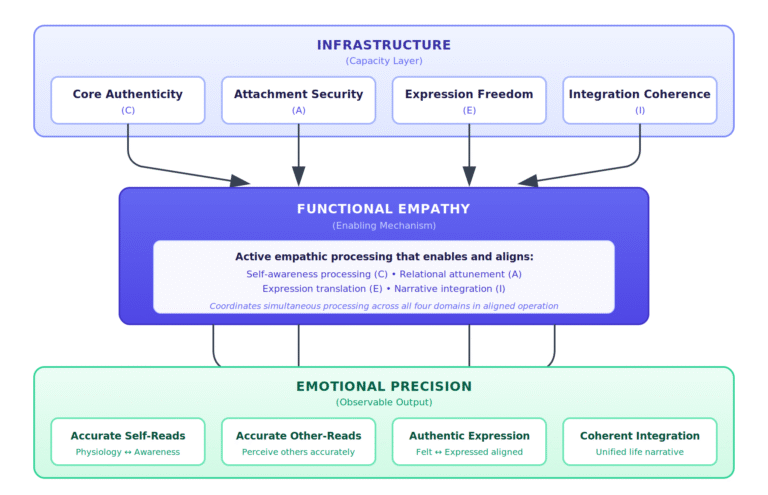
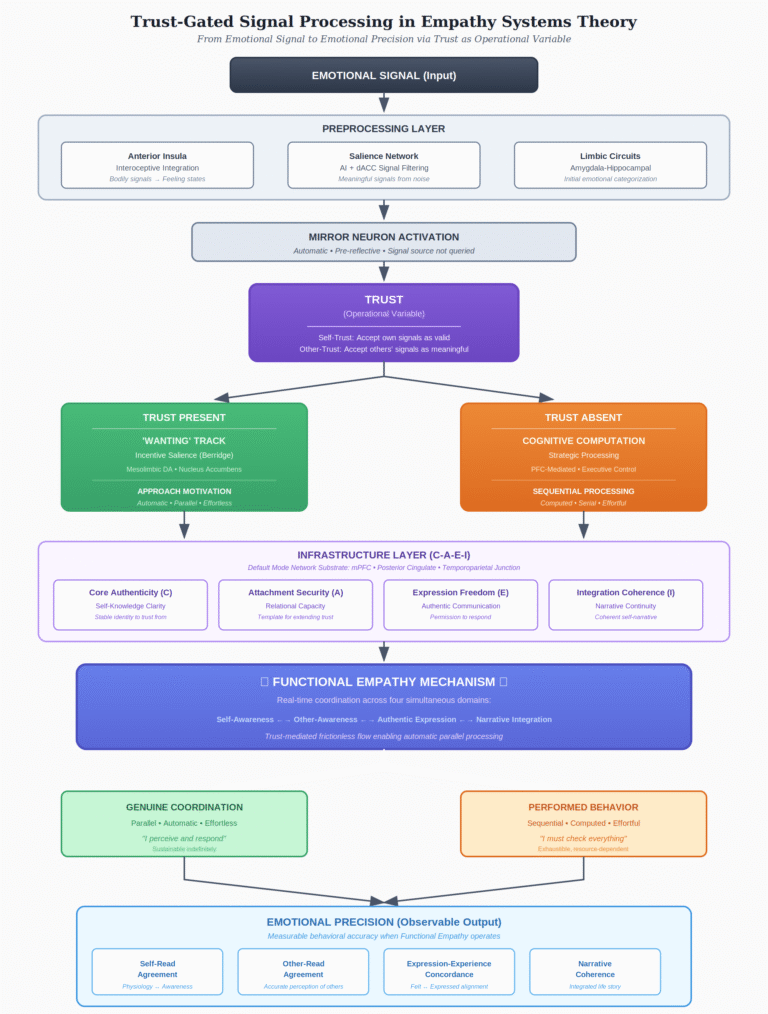
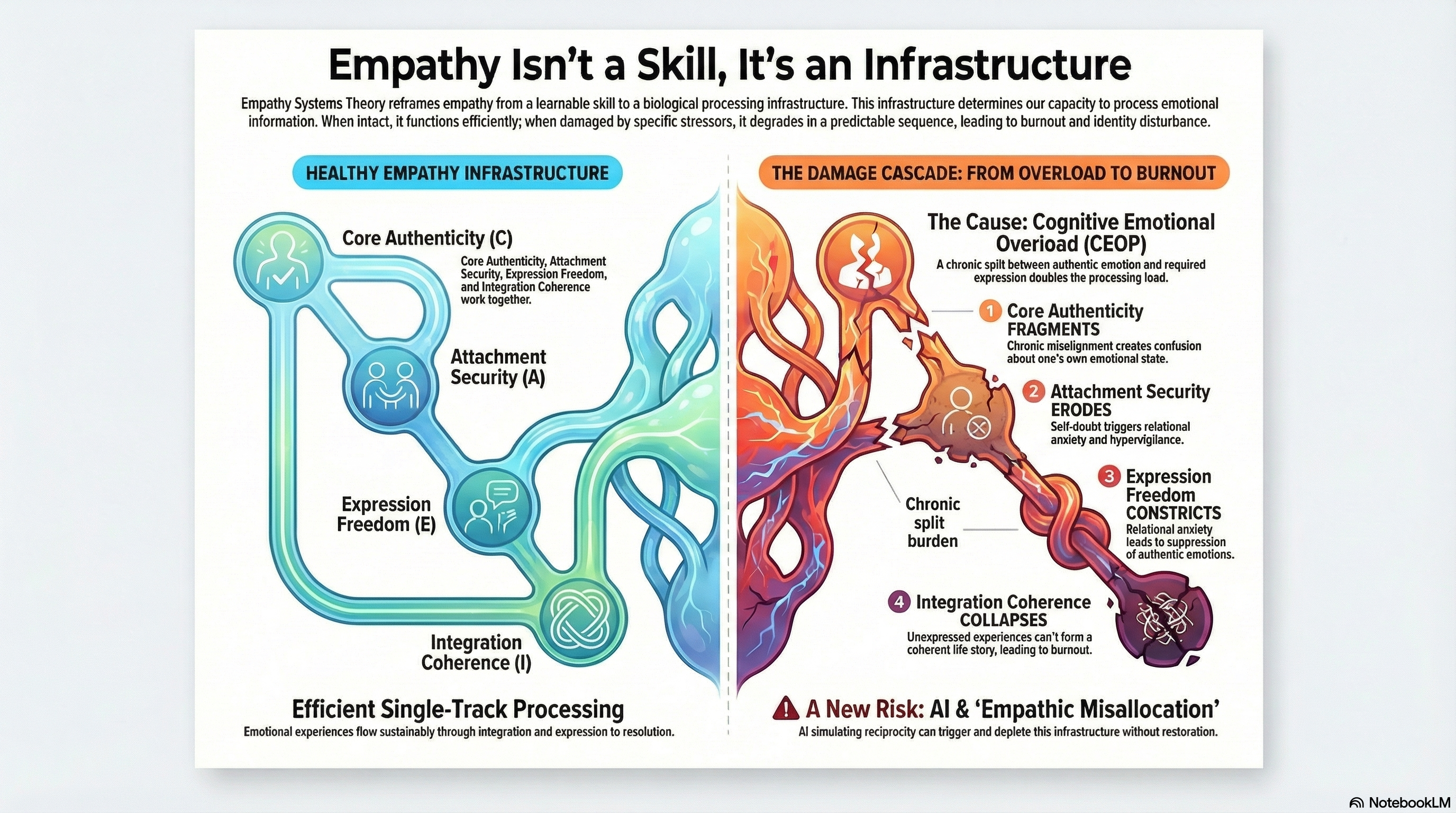
The theoretical foundation establishing empathy as biological infrastructure maintaining narrative coherence through four components: Core Authenticity, Attachment Security, Expression Freedom, and Integration Coherence (C-A-E-I). Completes William James’s 135-year-old discovery by identifying empathy as the mechanism maintaining associative networks.
Neural Foundations of Empathy Infrastructure: A Comprehensive Review
Mobley, D.D. (2026)
Neuroscience & Biobehavioral Reviews 🔬
Preprint 📄
Maps the C-A-E-I architecture to specific neural systems: Default Mode Network (Core Authenticity), Social Brain/Attachment System (Attachment Security), Prefrontal-Limbic Circuit (Expression Freedom), and Synthesis Network (Integration Coherence). Provides neurobiological validation for EST.
From Emotional Intelligence to Empathy Systems Theory: Why “Screen Before You Train”
Mobley, D.D. (2026)
Perspectives on Psychological Science 📝
Argues that empathy was historically understood as biological infrastructure but was incorrectly reframed as a trainable skill through popularization, explaining inconsistent outcomes in emotional intelligence training. Introduces CAEI-S as a screening tool.
Validation Infrastructure
Phenomenological Evidence Ecosystem
The Phenomenological Evidence Ecosystem: A Methodological Framework for Validating Empathy Systems Theory
Mobley, D.D. (2026)
OSF Preregistration
Preprint 📄
Introduces systematic protocols for transforming lived experience into scientifically evaluable evidence. Operationalizes the Recognition Principle through eight interdependent components: Role Bible, Evidence File Template, C-A-E-I Prompt Card, Counter-Instance Protocol, Entry Quality Checklist, Tag Reference Guide, Data Integrity Protocol, and Procedures Manual. Addresses historical challenges in first-person research—epistemic suspicion, confirmation bias, lack of forensic integrity. Builds on Petitmengin’s micro-phenomenology, Hurlburt’s DES, Varela’s neurophenomenology, and Giorgi’s descriptive method. Establishes new standard for first-person empathy research with prediction-verification structure, mandatory counter-instance documentation, and forensic-grade audit trail.
Philosophy of AI & Ethics
Non-Experiential Systems
Non-Experiential Systems and the Problem of Empathic Misallocation: A Philosophical Foundation for Emotional AI Governance
Mobley, D.D. (2026)
Minds and Machines 🔬
Preprint 📄
Introduces the concept of Non-Experiential Systems (NES)—AI systems that process emotional signals without experiencing emotions—and establishes empathic misallocation as a new category of harm where humans invest emotional resources in entities that cannot reciprocate care.
Letter on Meaning & Restraint: Philosophical Boundaries for Emotional AI
Mobley, D.D. (2026)
Ethics and Information Technology 📝
A philosophical boundary document establishing principles of restraint in AI systems that interact with human emotional infrastructure.
The Irreducible Human: Why Emotional AI Assessment Cannot Be Automated
Mobley, D.D. (2026)
AI & Society 📝
Establishes why human judgment remains irreducible in emotional AI governance. NES architecture means AI systems lack intrinsic motivation to protect human wellbeing—external human oversight cannot be automated away because internal care is structurally impossible.
Law & Policy
Legal Framework
The Six Harms Doctrine: A Legal Framework for Emotional AI Accountability
Mobley, D.D. (2026)
Preprint
Establishes cognizable injury taxonomy for emotional AI systems, providing legal foundation for regulatory enforcement and civil remedies.
Legal Harm Taxonomy for Algorithmic Emotional Manipulation
Mobley, D.D. (2026)
Berkeley Technology Law Journal 📝
Comprehensive classification of harm modalities created by AI systems that manipulate human emotional states, with regulatory recommendations.
Policy & Economics
Beyond Mandates: Market Mechanisms for Emotional AI Accountability
Mobley, D.D. (2026)
Issues in Science and Technology 📝
Argues that economic incentives drive compliance more effectively than regulatory mandates alone. Introduces the Empathy Economy framework—market-based accountability through Guardian certification, Empathy Credits, and Emotional Infrastructure Index (EII) ratings that make emotional safety economically rational.
Technical Architecture
HEART Framework
HEART Technical White Paper: Constitutional Governance for Emotional AI
Mobley, D.D. (2026)
IEEE ✅
Zenodo Preprint
Complete technical specification for the HEART Framework, including Seven Axioms, Four Core Principles, Master Emotional Core (MEC) architecture, EmotionID logging, UESP specifications, and cryptographic enforcement via Heart Validator Codes (HVC).
Knowing Feelings Without Having Them: The Dissociation Requirement for Emotional AI
Mobley, D.D. (2026)
Nature Machine Intelligence 📝
Technical specification for how AI systems can process emotional information while maintaining appropriate boundaries—the “knowing without having” principle central to NES architecture.
Measurement & Validation
Non-Compensatory Measurement for Constitutional Compliance: The Minimum-Average Product (MAP) Structure
Mobley, D.D. (2026)
Behavior Research Methods 📝
Introduces MAP (Φ = MIN × AVG), a novel measurement structure for constitutional compliance contexts where minimum thresholds represent inviolable requirements rather than optimization targets. Demonstrates application through the Functional Empathy Theorem (FET) for AI ethics certification. Addresses the measurement gap between binary pass/fail approaches and fully compensatory scales inappropriate for rights-based evaluation.
Applied Methodology
AI Empathy Forensics: Investigative Methodology for Algorithmic Emotional Manipulation
Mobley, D.D. (2026)
Champlain College Digital Forensics Capstone 📝
Investigation protocols for detecting, documenting, and proving algorithmic emotional manipulation. Applies digital forensics methodology to emotional AI accountability, providing practitioners with evidence-gathering frameworks for legal and regulatory proceedings.
Preprints & Working Papers
All publications are available as open-access preprints via Zenodo in addition to traditional peer-reviewed venues.
Citation
If citing this work, please use:
Mobley, D.D. (Year). [Title]. Journal Name. DOI: [DOI]
For preprints:
Mobley, D.D. (Year). [Title]. Zenodo. https://doi.org/10.5281/zenodo.XXXXXXX
Infographic Shareables Below